
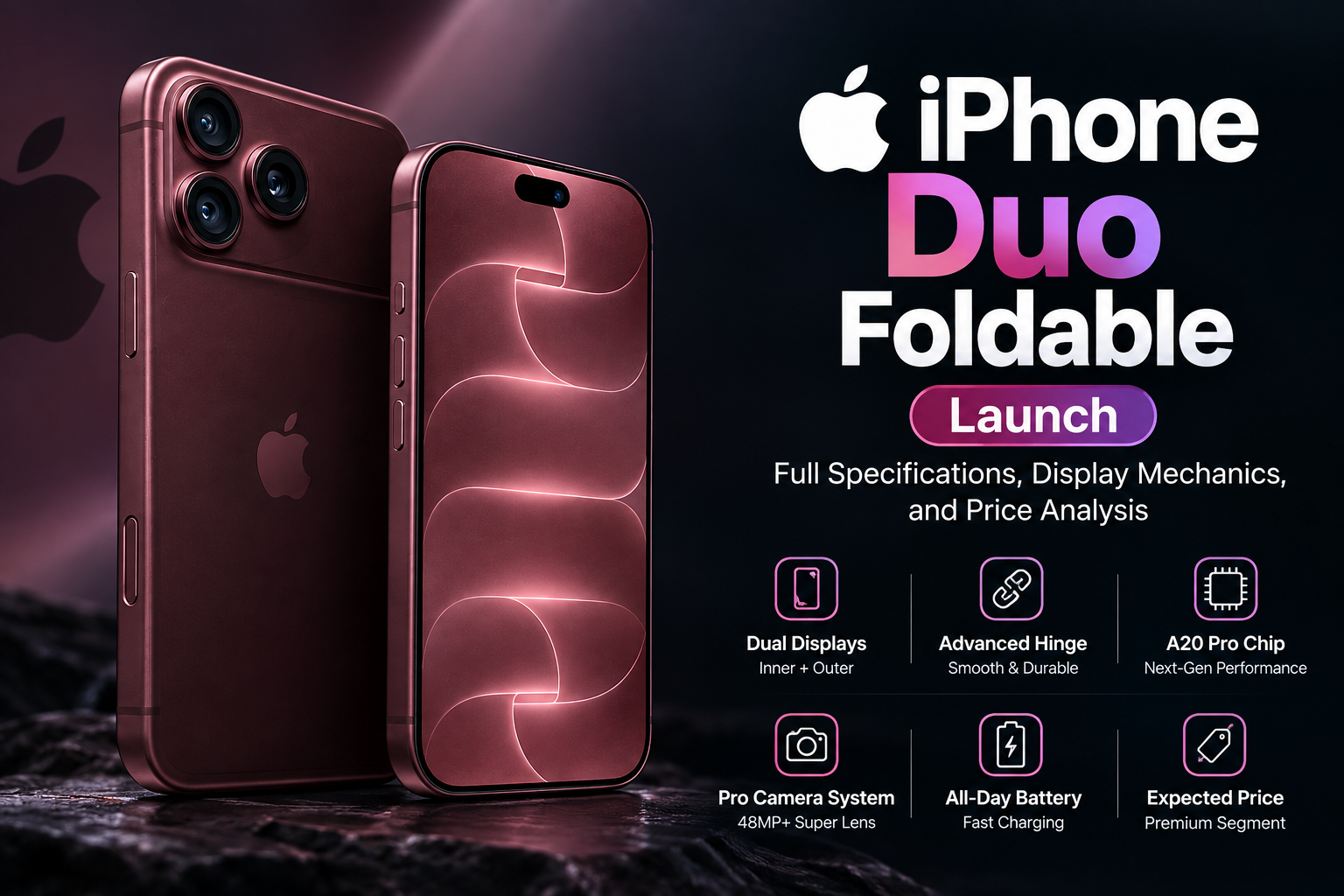
Full Specifications, Display Mechanics, and Price Analysis
Apple iphone duo foldable has officially announced its long-awaited entrance into the flexible screen market with the unveiling of the iPhone Duo. Unveiled alongside the traditional iPhone 18 Pro lineup, this novel form factor marks a major structural shift in Apple’s mobile hardware strategy. Search interest surrounding foldable display durability, multitasking performance, software adaptations, and international retail costs has surged across major global markets. This complete breakdown explores the technical specs, hinge design mechanics, camera trade-offs, and pricing structure of Apple’s flagship foldable device.
Book-Style Dual Display Architecture and Screen Dimensions
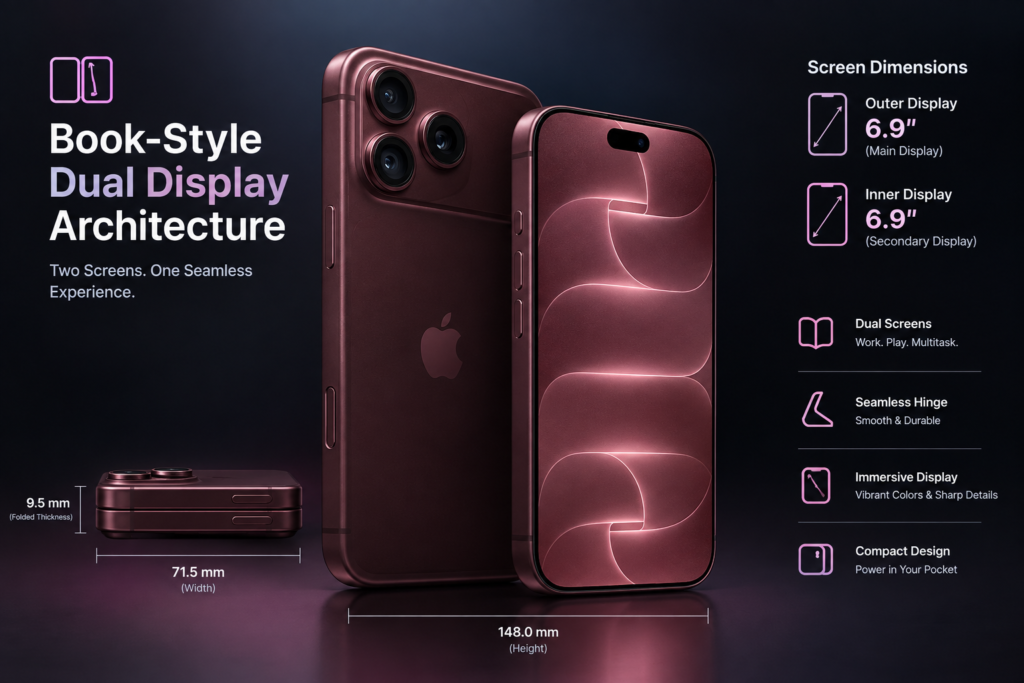
The defining physical feature of the device is its dual-screen book-style layout. Designed to function both as a compact smartphone and an expansive tablet alternative, the exterior features a 5.49-inch LTPO OLED cover display. This front panel provides a standard 4:3 aspect ratio, allowing users to handle quick notifications, text messages, and quick app actions without unfolding the main body.
Unfolding the chassis reveals a large 7.76-inch flexible inner OLED display. Apple’s display engineering team focused heavily on eliminating inner panel creasing. The inner panel utilizes multi-layer ultra-thin glass (UTG) supported by a liquid metal hinge mechanism, producing a nearly invisible crease across the main crease line.
- External Cover Display: 5.49-inch LTPO OLED screen with 120Hz ProMotion
- Internal Main Display: 7.76-inch Flexible OLED panel
- Unfolded Chassis Thickness: Ultra-thin 4.5mm profile
- Folded Chassis Thickness: 9.0mm compact footprint
Material Construction and Hybrid Metal Frame
To balance structural rigidity with physical weight management, Apple implemented a hybrid metal framework. Grade 5 Titanium is applied specifically to high-stress mechanical points and hinge housings to resist accidental drop impacts and bending forces.
The remaining chassis surfaces utilize high-grade aluminum to maximize thermal dissipation during intensive processing tasks. This structural combination keeps overall device weight manageable while maintaining an ultra-slim 4.5mm profile when open.
Touch ID Side Authentication vs Face ID Layout
Unlike traditional Pro models featuring Dynamic Island TrueDepth sensor arrays, the folding hardware drops Face ID entirely. Due to extreme thinness inside the display bezels, housing complex infrared dot projectors proved physically unfeasible without increasing total device thickness.
Instead, Apple reintroduced biometric Touch ID, integrating a capacitive fingerprint scanner directly into the side-mounted power button. Users can unlock the device or authenticate Apple Pay transactions instantly whether the phone is closed or fully open. Both internal and external screens feature minimalist punch-hole camera cutouts dedicated strictly to video calling and selfie capture.
Dual 48MP Rear Camera Setup and Hardware Trade-Offs
Because internal volume is split across two thin housing halves, space for camera modules is strictly constrained. Consequently, the device bypasses the heavy 3-lens layout seen on Pro Max models in favor of a dual 48MP rear camera array.
- Primary Sensor: 48MP Fusion lens featuring optical image stabilization.
- Ultra-Wide Sensor: 48MP sensor with macro shooting capabilities.
While the absence of a dedicated telephoto zoom lens is a notable trade-off for mobile photography enthusiasts, computational cropping on the primary 48MP sensor provides lossless 2x optical zoom quality for daily shooting conditions.
A20 Pro Performance, Dual Battery System, and Charging
Underneath the hood, the folding flagship shares the exact same 2nm A20 Pro chipset found inside the flagship Pro series. Paired with 12GB of unified LPDDR6 memory, the chip effortlessly manages complex multi-window workflows, side-by-side app split screens, and background AI processing.
Power distribution relies on a dual-battery layout split across both halves of the folding frame. Combined cell capacity reaches between 5,400mAh and 5,800mAh, providing enough operational power to sustain the large 7.76-inch main display throughout a full working day. Fast charging protocols support 60W wired USB-PD chargers along with 25W MagSafe wireless pads.
Global Price Breakdown Across Target Regions
Positioned iphone duo foldable as an ultra-premium hardware category above the Pro Max lineup, baseline pricing starts at $1,999 USD for 256GB storage. Below is the official multi-currency pricing sheet for global buyers:
| Country | Local Currency | 256GB Model | 512GB Model | 1TB Model |
| United States | USD ($) | $1,999 | $2,199 | $2,399 |
| France | EUR (€) | €2,249 | €2,499 | €2,749 |
| Germany | EUR (€) | €2,249 | €2,499 | €2,749 |
| Canada | CAD ($) | CA$2,749 | CA$2,999 | CA$3,299 |
| Spain | EUR (€) | €2,249 | €2,499 | €2,749 |
| Turkey | TRY (₺) | ₺149,999 | ₺164,999 | ₺179,999 |
| India | INR (₹) | ₹2,19,900 | ₹2,39,900 | ₹2,59,900 |
Frequently Asked Questions
Does the iPhone Duo support Apple Pencil input?
Early iOS 27 system code indicates support for compact stylus accessories on the main 7.76-inch display, though official styluses are sold separately.
Is Face ID available on the foldable iPhone?
No, Face ID has been replaced with a Touch ID sensor built into the side power button.
When do pre-orders start for the folding model?
Pre-orders open alongside the Pro lineup on Saturday, September 12, 2026, with store shipments starting September 18.
How thick is the phone when unfolded?
The device measures an ultra-thin 4.5mm when completely opened flat.